

Technological Breakthrough: Research by AI and Digital Science Institute Recognised at AI Journey 2025
Researchers from the AI and Digital Science Institute (part of the HSE Faculty of Computer Science) presented cutting-edge AI studies, noted for their scientific novelty and practical relevance, at the AI Journey 2025 International Conference. A research project by Maxim Rakhuba, Head of the Laboratory for Matrix and Tensor Methods in Machine Learning, received the AI Leaders 2025 award. Aibek Alanov, Head of the Centre of Deep Learning and Bayesian Methods, was among the finalists.
Maxim Rakhuba received high praise from the scientific community and was awarded the national AI Leaders award for his outstanding contribution to the development of efficient modelling methods and big data processing. His project focuses on designing new approaches to accelerating and reducing the size of machine-learning models through the use of low-dimensional matrices and tensors. These techniques significantly boost the performance of deep-learning algorithms and reduce the resource demands of servers and data centres.

‘The approaches we are developing make it possible, for example, to reduce the number of parameters in modern neural networks, making them more accessible and efficient, which broadens the scope for their application,’ emphasised Maxim Rakhuba.
Aibek Alanov made it to the finals with his project ‘Efficient Control Mechanisms for Image and Audio Generative Models.’ His research focuses on adaptation and personalisation, editing real images without additional training, and improving low-latency speech quality for real-time applications.

As part of the Breakthrough Research and Technology session, Alexey Naumov, Director of the AI and Digital Science Institute, delivered a presentation entitled ‘Estimating Schrödinger Potentials.’ Sergey Samsonov, Head of the International Laboratory of Stochastic Algorithms and High-Dimensional Inference, presented his talk on ‘Training Methods for Generative Flow Networks.’

Vladimir Spokoiny, Academic Supervisor of the HSE Laboratory for Theoretical Foundations of AI Models, presented a study titled ‘Estimation and Inference of Deep Neural Networks.’ His talk addressed some of the most pressing challenges in modern machine learning, including predictive accuracy and the reliability of inference—issues of particular importance given the growing scale and complexity of AI applications.
Peter Lukianchenko, Head of the HSE Laboratory of Artificial Intelligence in Mathematical Finance, shared successful experience of applying AI within the financial services sector during the session ‘Artificial Intelligence in Customer Experience and Personalisation.’ His presentation focused on the development of a multi-agent simulator designed to recreate crisis events in financial markets.
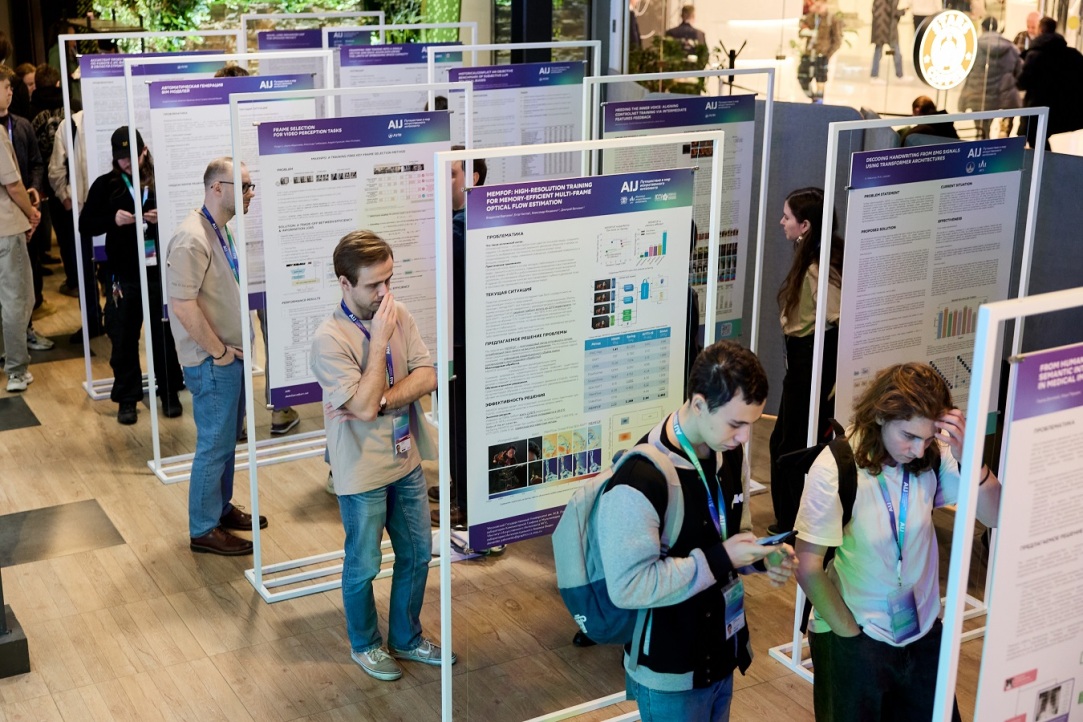
Researchers from the institute also presented a number of important studies during the poster session, including scientific results obtained under a grant from the Third-Wave Artificial Intelligence Centre.
GAS: Improving Discretisation of Diffusion ODEs via Generalised Adversarial Solver.
Authors: Alexander Oganov, Ilya Bykov, Eva Neudachina, Mishan Aliev, Alexandr Tolmachev, Alexandr Sidorov, Alexandr Zuev, Andrey Okhotin, Denis Rakitin, Aibek Alanov.
Revisiting Non-Acyclic GFlowNets in Discrete Environments.
Authors: Nikita Morozov, Yan Maximov, Daniil Tiapkin, Sergey Samsonov.
A System for Automatic Multimodal Analysis of Emotions and Personality Traits Based on Semi-Supervised Cross-Domain Learning.
Authors: Elena Ryumina, Alexander Aksenov, Daria Koryakovskaya, Timur Abdulkadirov, Angelina Egorova, Sergey Fedchin, Alexander Zaburdaev, Dmitry Ryumin.
Evaluation of Tokeniser Adaptation Methods for Russian LLMs.
Authors: Georgy Andryushchenko, Maria Godunova, Vladimir Ivanov, Dmitry Kuzmin, Andrew Parinov, Anna Shchennikova, Elizaveta Zhemchuzhina.
OmicsFUSION: GenAI model for Omics Data.
Authors: Nazar Beknazarov, Artem Bashkatov, Maria Poptsova.
A delegation from the institute also attended other AI Journey 2025 events to support active engagement within the scientific community and to discuss new directions in the development of artificial intelligence technologies.

Anna Kozyreva
‘The participation of representatives from the AI and Digital Science Institute in AI Journey fosters the exchange of scientific ideas with leading experts, helps to establish partnerships, and encourages discussion of future growth areas. The expansion of the international scientific community is particularly valuable and helps to define more clearly the pathways for further progress in AI,’ noted Anna Kozyreva, Head of the institute’s Promotions and Communications Unit.
By maintaining a high level of research activity and continually advancing technological approaches, the HSE AI and Digital Science Institute reaffirms its leading position in the development of artificial intelligence and related scientific fields in Russia.
Timur Abdulkhadirov
Alexander Aksenov
Georgy Andryushchenko
Maria Godunova
Alexander Zuev
Vladimir Ivanov
Darya Koryakovskaya
Dmitry Kuzmin
Elena Ryumina
Alexander Sidorov
Anna Schennikova
See also:

School Students Master Communication with GigaChat at HSE and Sber Hackathon
In late December 2025, a unique competition was held at HSE University where participants solved challenges not by writing code, but solely by interacting with Sber’s GigaChat artificial intelligence model. The Improm(p)tu hackathon was an experiment less about programming skills than a new form of literacy: the ability to work effectively with AI by translating complex problems into a language neural networks can understand.
Artificial Intelligence Transforms Employment in Russian Companies
Russian enterprises rank among the world’s top ten leaders in AI adoption. In 2023, nearly one-third of domestic companies reported using artificial intelligence. According to a new study by Larisa Smirnykh, Professor at the HSE Faculty of Economic Sciences, the impact of digitalisation on employment is uneven: while the introduction of AI in small and large enterprises led to a reduction in the number of employees, in medium-sized companies, on the contrary, it contributed to job growth. The article has been published in Voprosy Ekonomiki.
'At the Intersection of Mathematics, Biology, and Machine Learning, I Found My Place'
Aleksei Shmelev conducts research in genomics and uses machine learning to explore the history of human populations. In this interview with the HSE Young Scientists project, he discusses the adaptive introgression of Tibetans and Denisovans and the use of IBD graphs to predict human population membership.
HSE Seeks New Ideas for AI Agents: Initiative Competition Launched
HSE University is inviting researchers and lecturers to present concepts for new digital products based on artificial intelligence. The best projects will receive expert and technological support. Applications are open until December 19, 2025.
Final of International Yandex–HSE Olympiad in AI and Data Analysis Held at HSE University
Yandex Education and the HSE Faculty of Computer Science have announced the results of the international AIDAO (Artificial Intelligence and Data Analysis Olympiad) competition. Students from 14 countries took part. For the second year in a row, first place went to the team AI Capybara, which developed the most accurate AI model for an autonomous vehicle vision system.
AI Lingua Included in Compilation of Best International AI Practices in Higher Education
HSE University has been acknowledged internationally for its pioneering efforts in integrating artificial intelligence into higher education. The AI Lingua Neural Network developed at HSE was included in the renowned international collection ‘The Global Development of AI-Empowered Higher Education: Beyond the Horizon.’ The compilation was prepared by the Institute of Education (IOE) of Tsinghua University with the support of the Ministry of Education of the People's Republic of China and a global advisory committee, which included experts from Oxford, UCL, Sorbonne, Stanford, and other leading academic centres.
HSE Lecturers Awarded Yandex ML Prize 2025
The Yandex ML Prize is awarded to lecturers and heads of educational programmes who contribute to the development of artificial intelligence in Russia. This year, 10 laureates were selected from 300 applicants, including three members of the HSE Faculty of Computer Science (FCS). A special Hall of Fame award was also presented for contributions to the establishment of machine learning as an academic field. One of the recipients was Dmitry Vetrov, Research Professor at the HSE FCS.
HSE University to Join Physical AI Garage Project by Yandex
Yandex is collaborating with leading Russian universities to launch a new educational programme called Physical AI Garage. This initiative unites five universities—HSE University, ITMO, MIPT, MAI, and MEPhI—to train future professionals in physical artificial intelligence by tackling real-world industrial challenges. The programme is free, and participants will receive scholarships.
Larger Groups of Students Use AI More Effectively in Learning
Researchers at the Institute of Education and the Faculty of Economic Sciences at HSE University have studied what factors determine the success of student group projects when they are completed with the help of artificial intelligence (AI). Their findings suggest that, in addition to the knowledge level of the team members, the size of the group also plays a significant role—the larger it is, the more efficient the process becomes. The study was published in Innovations in Education and Teaching International.
Clouds Are Closer Than They Appear: Results of iFORA Foresight Session
Management intellectualisation, synergy with AI, and the transition to microclouds are expected to be the main trends in the digital economy over the next decade. Experts in cloud technologies gathered at HSE University for a foresight session to discuss these trends and their evolution up to 2040. They explored how process intellectualisation would develop, as well as ideas for storing data in space to minimise environmental impact.