

‘Territory of the Future. Moscow 2030’ Forum-Festival to Feature Innovative Projects from HSE Graduates
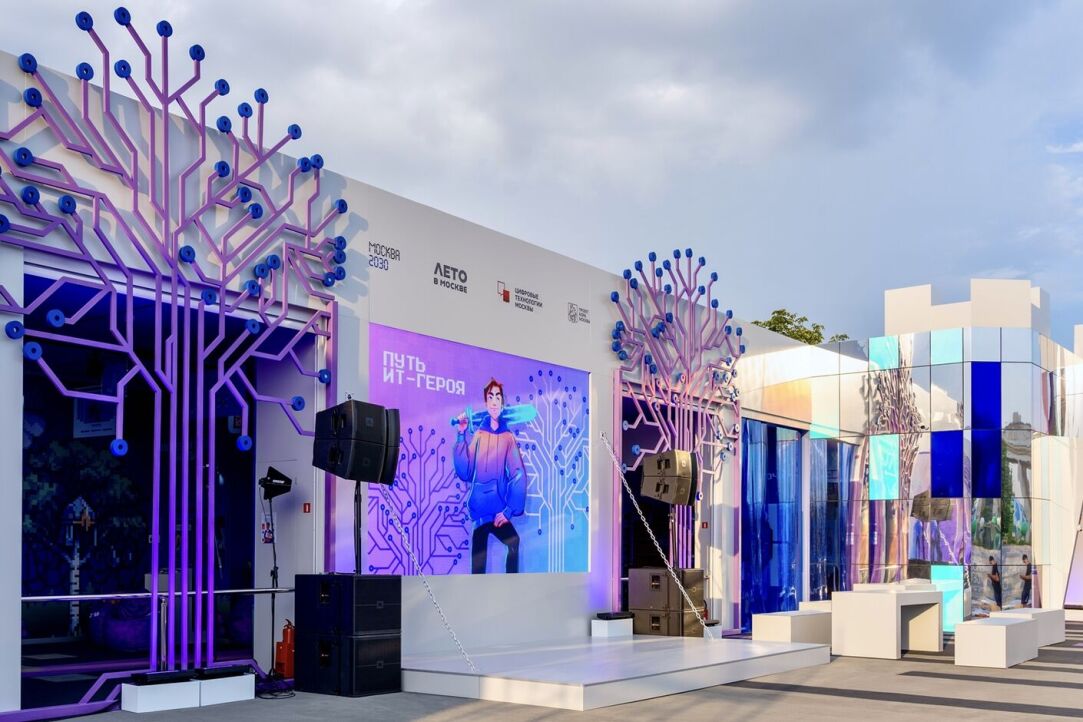
Until September 14, 2025, the Russian capital is hosting a large-scale forum-festival called ‘Territory of the Future: Moscow 2030’ —a space for technology, science, and innovation. This event showcases cutting-edge developments in medicine, astronautics, and the digital economy. HSE Art and Design School is participating in the festival with two graduate projects in Product and Industrial Design.
The forum-festival ‘Territory of the Future. Moscow 2030’ is taking place at 11 different venues throughout the capital, including VDNKh, Gostiny Dvor, Zaryadye Park, Krasny Oktyabr, Luzhniki, the Manege, Bauman Moscow State Technical University’s new campus, Muzeon Art Park, 50th Anniversary of October Park, Skolkovo, and Kinozavod Moskino. As part of the ‘Summer in Moscow’ project, this large-scale event allows guests to not only witness but also experience some of the most cutting-edge developments in robotics, AI, digital urban services, and innovations in education and medicine.
Muzeon Art Park, one of the festival venues, hosts the exhibition ‘Digital Technologies of Moscow’ presented by the Moscow Department of Information Technology. Here, visitors can take an interactive journey called ‘The Path of the IT Hero’ and see the prototypes of two projects created by students of HSE Art and Design School under the guidance of Maria Stepanova, Head of the Product and Industrial Design department. These objects demonstrate how modern design has become an essential element of engineering and scientific solutions, combining aesthetics and functionality.
Maria Stepanova: ‘I am pleased that our students are exploring new technologies and joining interdisciplinary teams with scientists and engineers. This is a significant and ambitious step towards contributing to the development of the medical and space industries through design. I hope that participation in a large-scale project like “Moscow 2030” will provide students with new opportunities to collaborate and implement their projects.’
One of the projects presented is Ance, developed by graduate Egor Ugrimov. This is a high-tech device for inactivating pathogens in donated blood using ultraviolet radiation. Ance enhances the safety of blood transfusion by efficiently disinfecting it from viruses and bacteria. The design of the device is based on simplicity and cleanliness, with smooth shapes, minimalistic aesthetics, and thoughtful ergonomics that make it a natural fit in the modern medical environment.


The second project is Belka, Russia’s first autonomous flying robot created to operate in zero gravity on the International Space Station. The robot was designed by Anastasia Kogteva, a graduate of HSE Art and Design School, with the support of S.P. Korolev Rocket and Space Corporation ‘Energia’ as well as collaboration from Lomonosov Moscow State University and its Institute of Mechanics. Belka moves by releasing compressed air instead of using traditional engines. Its intelligent navigation system, based on LiDAR, depth cameras, and neural networks, allows it to navigate independently in the confined space of the station. Soft protective elements on its exterior help prevent collisions, and its friendly appearance fosters comfortable interaction with astronauts.


Furthermore, a presentation of the mediiia platform can be viewed at the ‘Digital Technologies of Moscow’ exhibition.
mediiia is a platform intended for the quick launch of creative projects developed by HSE Art and Design School. Here, users can create a digital portfolio, online exhibition, competition, course, media, or marketplace. The platform offers a longread constructor, tools for creating, promoting, and monetising special projects, as well as organising communities.
mediiia has dozens of projects related to design, art, and education, ranging from storefronts and museums to fashion markets and gaming platforms.
Join mediiia’s flagship projects:
- deziiign.com—a platform for design portfolios and contests;
- artz.work—a community of artists, photographers, and illustrators;
- brnd.ru—a marketplace for young brands and an incubator for creative startups;
- kiiids.art—a museum of children’s art;
- gallllery.com—a virtual gallery and services for collecting digital art.
The ‘Territory of the Future. Moscow 2030’ forum-festival opened on August 1 and will continue until September 14, 2025, at 11 locations in Moscow. The works of HSE Art and Design School graduates can be viewed at the Muzeon Art Park as part of the ‘Digital Technologies of Moscow’ exhibition.
Throughout the first half of September, the forum-festival will feature lectures with experts from HSE Art and Design School. Stay tuned for more updates!

See also:

HSE University to Develop Predictive Analytics System for Icebreaker Motors
Industrial automation is one of the key applications of artificial intelligence. A predictive analytics system for large electric motors is among the solutions being developed for the industry as part of HSE University’s Strategic Technological Project ‘Multi-Agent Platform of AI Solutions for Industry-Specific Tasks.’ What is predictive analytics, how can it improve the operation of electric motors, and what specialists joined forces to develop this technology? Anton Zarubin, Dean of the School of Computer Science, Physics, and Technology at HSE University–St Petersburg and the project development coordinator, explains in this interview with the HSE News Service.
Scientific Expedition to Hainan: HSE Scientists Organise Conference on Statistical AI in China
The Statistical AI Conference was held in Sanya, Hainan Island, China, from 24 to 28 August 2026. The international event brought together leading experts in statistics, machine learning, and applied AI. Alexey Naumov, Director of the AI and Digital Science Institute at the HSE Faculty of Computer Science, and Sergey Samsonov, Head of the International Laboratory of Stochastic Algorithms and High-Dimensional Inference, were among the conference organisers.
5th Fall into ML Conference to Bring Together Leading AI Researchers
The AI and Digital Science Institute at the HSE Faculty of Computer Science invites researchers, developers and everyone shaping the future of technology to the fifth, anniversary edition of the Fall into Machine Learning conference (Fall into ML 2026). The event will take place on October 23–24, 2026, at the HSE Cultural Centre in Moscow and will become the key meeting point for Russia’s AI community.
HSE University to Present Its Projects at the International Youth Festival
The International Youth Festival (IYF) will be held in Yekaterinburg from 11 to 17 September 2026. HSE University will take an active part in the event. The university's booth will present a space settlement mock-up, robots, and the iFORA big data analysis system. Fifty HSE students will visit festival venues, and experts will participate in the business programme.
HSE University Expands Cooperation with Malaysia in Technology Foresight
HSE University researchers will take part in a study of the future of engineering education in Malaysia, while the Malaysian Industry-Government Group for High Technology (MIGHT) will use the iFORA big-data analysis system to validate the findings of its foresight research. These are the outcomes of a visit by HSE representatives to Kuala Lumpur.
Scientists Train Neural Network to Generate Process Plans from 3D Models
Researchers at the HSE FCS AI and Digital Science Institute have developed CAD2TechSpec, a framework that converts 3D models of mechanical parts into machining process plans—step-by-step instructions for machine tools. The solution aims to reduce the time required for the design and preparation of technical process documentation in mechanical engineering, aircraft manufacturing, and other high-tech industries. The study findings have been published in PeerJ Computer Science.
Biologists Discover 'Molecular Fingerprint' of Preeclampsia
Researchers at HSE University employed a new method to model hypoxia in placental cells during pregnancies complicated by preeclampsia and identified molecular markers of tissue hypoxia. Since hypoxia is one of the key mechanisms underlying preeclampsia, these findings are important for a more accurate and timely diagnosis of the disease and for the development of effective treatment methods. The paper has been published in Placenta.
Laboratory of Future Networks: HSE Telecommunications Research Institute Develops 5G/6G Research Testbed
The 5G/6G testbed at the HSE Telecommunications Research Institute is becoming a research platform, an educational laboratory, and a foundation for developing new software components for future networks. It makes it possible not only to observe how a mobile network operates, but also to change its operating conditions and measure the results: data-transmission speed, latency, errors, radio-resource utilisation, and other parameters. Based on the testbed, researchers plan to develop MIMO, O-RAN, xApp, and IAB technologies, as well as experiment with artificial intelligence.
‘Hedgehog’ Versus ‘Relatives’: Researchers Measure How the Brain Responds to Unexpected Words During Natural Speech
Russian neurophysiologists, including researchers from HSE University, have demonstrated the feasibility of using event-related fields (ERFs) to study brain activity during natural speech perception. The researchers showed that this approach can be applied not only to individual words but also to continuous speech. Their findings indicate that words whose meanings differ significantly from the preceding context require longer processing times. The study also reveals that the brain processes function words in two stages: first, it identifies their grammatical role and then uses this information to predict the next word. The study has been published in Frontiers in Human Neuroscience.
Hybrid Intelligence: Competencies in the Age of AI Discussed at Technoprom-2026
Artificial intelligence is not creating new professions, but rather transforming the nature of existing ones. This was the conclusion reached by participants in the panel session ‘Hybrid Intelligence: Digital and Human Drivers of Development,’ organised by the Institute for Statistical Studies and Economics of Knowledge (ISSEK) at HSE University as part of the 13th International Forum of Technological Development (Technoprom-2026). The experts discussed how the nature of work is changing, which skills are becoming increasingly sought after, and what prevents companies from fully capitalising on new technologies.