

Fifteen Minutes on Foot: How Post-Soviet Cities Manage Access to Essential Services

Researchers from HSE University and the Institute of Geography of the Russian Academy of Sciences analysed three major Russian cities to assess their alignment with the '15-minute city' concept—an urban design that ensures residents can easily access essential services and facilities within walking distance. Naberezhnye Chelny, where most residents live in Soviet-era microdistricts, demonstrated the highest levels of accessibility. In Krasnodar, fewer than half of residents can easily reach essential facilities on foot, and in Saratov, just over a third can. The article has been published in Regional Research of Russia.
Humanity is increasingly drawn to urban life, with both the number and size of cities continuing to grow. According to Rosstat, as of January 1, 2023, approximately 109.7 million people in Russia—around 75% of the country’s population—lived in cities. Alongside urban growth, problems in the urban environment are also intensifying, including social inequality, uneven access to infrastructure, and negative environmental impacts. The concept of a 15-minute city has been proposed as one potential solution to these problems, aiming to ensure equitable access to basic services and reduce pressure on transportation systems. It envisions cities designed so that every resident can reach essential services—such as education, healthcare, shopping, and leisure—within a 15-minute walk or bicycle ride.
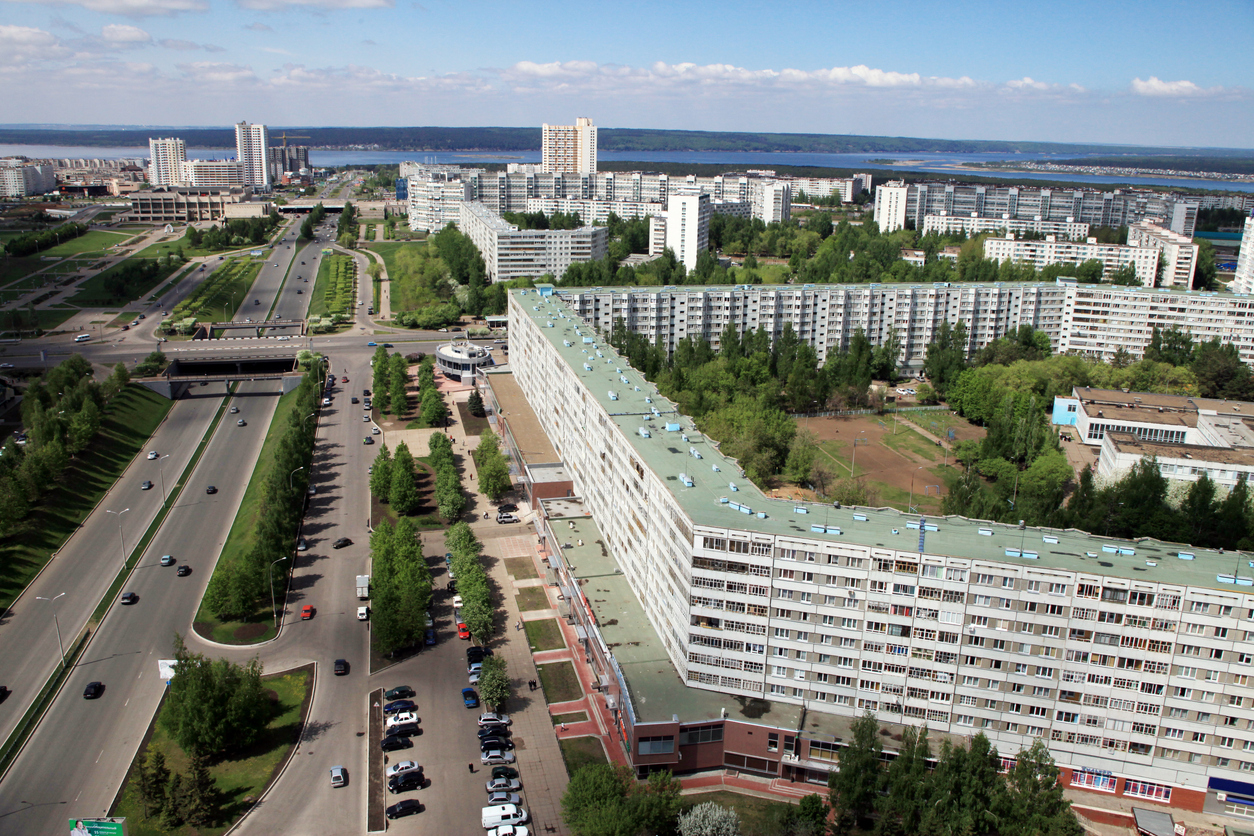
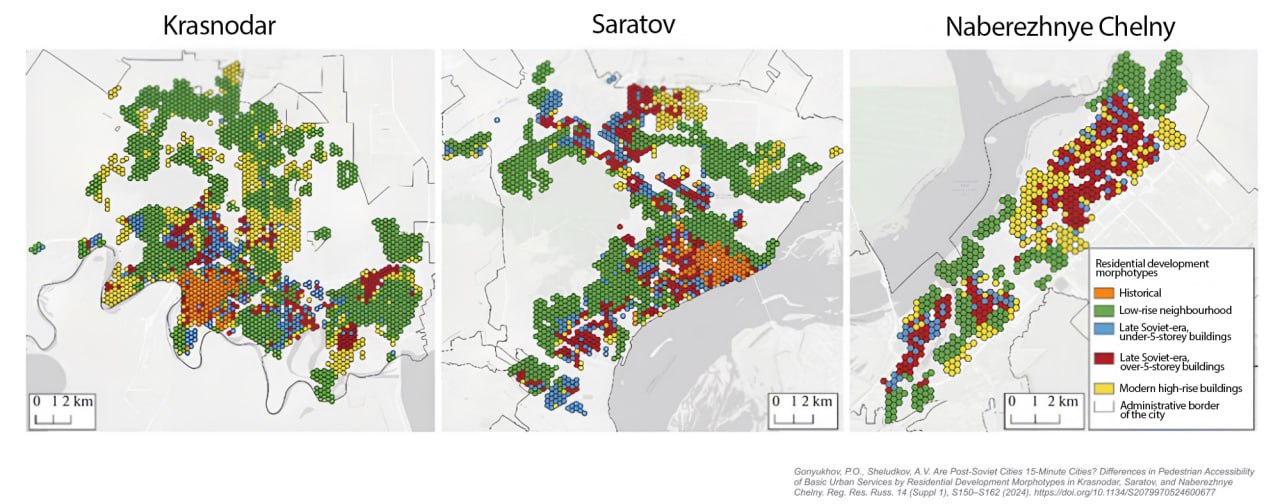
Researchers at HSE University and the RAS Institute of Geography studied the accessibility of essential services in three major Russian cities: Krasnodar, Saratov, and Naberezhnye Chelny. These cities clearly demonstrate the diversity of urban environments, each with its own characteristics: the historically established centre in Saratov, the extensive private housing sector in Krasnodar, the Soviet-era microdistricts in Naberezhnye Chelny, and the ongoing development of modern high-rise apartment buildings in all three cities.
The researchers used urban infrastructure data from 2GIS and OSM to evaluate how easily residents of large cities can access various services on foot. The team analysed the locations of 23 types of urban facilities, including kindergartens, schools, hospitals, stores, public transport stops, and more, and calculated a comprehensive accessibility index for urban infrastructure.
Naberezhnye Chelny, where most residents live in Soviet-era microdistricts, proved to be the closest to the 15-minute city model. There, 74% of residents live within a 15-minute walk of all essential facilities they might need. In Saratov, where the hilly terrain fragments the urban space, only 34.7% enjoy this level of accessibility, while in Krasnodar—with its extensive areas of private low-rise housing—the figure is 46.5%.
The researchers paid particular attention to how service accessibility varies across different neighbourhood types: historical centres, Soviet-era microdistricts, modern high-rise residential blocks, and areas of low-rise private houses.
The highest accessibility was observed in historical centres, where essential facilities are concentrated and located within walking distance. These areas often include higher-tier urban services—such as theatres, museums, and universities—which significantly enhance residents' quality of life. Soviet-era microdistricts also delivered strong results, outperforming modern high-rise residential complexes, where housing development often outpaces the provision of necessary infrastructure.
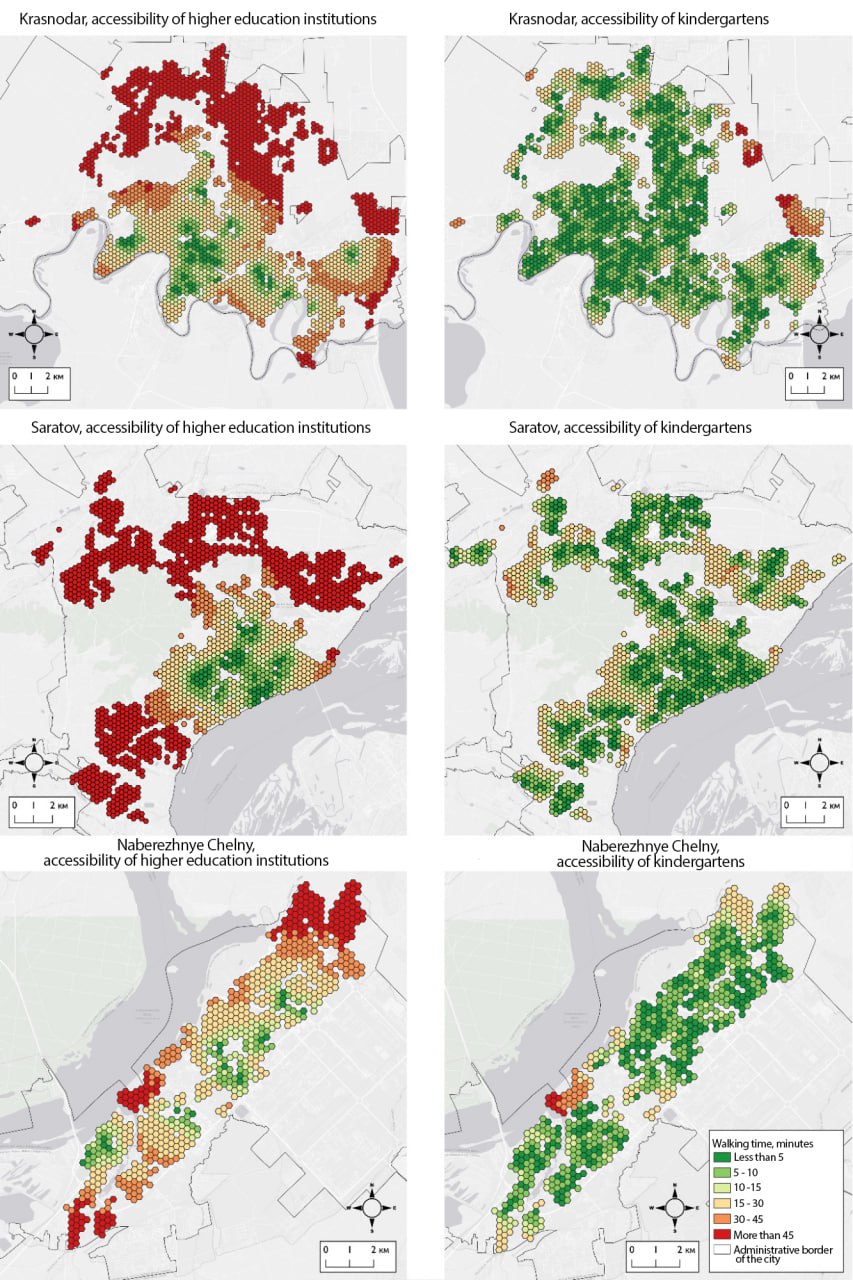
The lowest accessibility was found in low-rise neighbourhoods, especially on the outskirts of cities, where the average walking time to infrastructure facilities was three times longer than in historical centres and twice as long as in Soviet-era microdistricts.
However, when focusing only on essential everyday facilities—such as stores, public transport stops, and schools—and excluding unique institutions like theatres or universities, the differences between cities become less pronounced, with 86% to 92% of residents in each city living within a 15-minute walk of essential services.

Petr Gonyukhov
'To improve the accessibility of essential facilities, which are often concentrated in city centres, it is important to develop transportation networks and establish smaller service hubs directly within residential neighbourhoods. A separate challenge in suburban private-housing areas is that shops and services tend to emerge spontaneously near bus stops and intersections, forcing residents to spend more time traveling to reach them,' explains Petr Gonyukhov, a master's student at the HSE Faculty of Urban and Regional Development and co-author of the article.
These recommendations are particularly relevant for post-Soviet cities, where most residents still live in typical Soviet-era buildings. To improve access to essential services in new neighbourhoods, it is important to establish additional activity hubs and develop public transportation systems.
'The accessibility index provides a clear picture of where cities already align with the concept of a comfortable urban space and where additional efforts are needed to improve infrastructure. This data is valuable for both urban planners and residents, as it helps identify critical areas and guide urban development efforts,' sums up Alexander Sheludkov, Associate Professor at the Joint Department with the RAS Institute of Geography of the HSE Faculty of Geography and Geoinformation Technology and co-author of the article.
The study was conducted as part of the Spatial Analysis and Modelling of Urban Processes project implemented by the Research and Study Group at the HSE Faculty of Geography and Geoinformation Technology.
See also:

Scientists Test Asymmetry Between Matter and Antimatter
An international team, including scientists from HSE University, has collected and analysed data from dozens of experiments on charm mixing—the process in which an unstable charm meson oscillates between its particle and antiparticle states. These oscillations were observed only four times per thousand decays, fully consistent with the predictions of the Standard Model. This indicates that no signs of new physics have yet been detected in these processes, and if unknown particles do exist, they are likely too heavy to be observed with current equipment. The paper has been published in Physical Review D.
HSE Scientists Reveal What Drives Public Trust in Science
Researchers at HSE ISSEK have analysed the level of trust in scientific knowledge in Russian society and the factors shaping attitudes and perceptions. It was found that trust in science depends more on everyday experience, social expectations, and the perceived promises of science than on objective knowledge. The article has been published in Universe of Russia.
Scientists Uncover Why Consumers Are Reluctant to Pay for Sugar-Free Products
Researchers at the HSE Institute for Cognitive Neuroscience have investigated how 'sugar-free' labelling affects consumers’ willingness to pay for such products. It was found that the label has little impact on the products’ appeal due to a trade-off between sweetness and healthiness: on the one hand, the label can deter consumers by implying an inferior taste, while on the other, it signals potential health benefits. The study findings have been published in Frontiers in Nutrition.
HSE Psycholinguists Launch Digital Tool to Spot Dyslexia in Children
Specialists from HSE University's Centre for Language and Brain have introduced LexiMetr, a new digital tool for diagnosing dyslexia in primary school students. This is the first standardised application in Russia that enables fast and reliable assessment of children’s reading skills to identify dyslexia or the risk of developing it. The application is available on the RuStore platform and runs on Android tablets.
Physicists Propose New Mechanism to Enhance Superconductivity with 'Quantum Glue'
A team of researchers, including scientists from HSE MIEM, has demonstrated that defects in a material can enhance, rather than hinder, superconductivity. This occurs through interaction between defective and cleaner regions, which creates a 'quantum glue'—a uniform component that binds distinct superconducting regions into a single network. Calculations confirm that this mechanism could aid in developing superconductors that operate at higher temperatures. The study has been published in Communications Physics.
Neural Network Trained to Predict Crises in Russian Stock Market
Economists from HSE University have developed a neural network model that can predict the onset of a short-term stock market crisis with over 83% accuracy, one day in advance. The model performs well even on complex, imbalanced data and incorporates not only economic indicators but also investor sentiment. The paper by Tamara Teplova, Maksim Fayzulin, and Aleksei Kurkin from the Centre for Financial Research and Data Analytics at the HSE Faculty of Economic Sciences has been published in Socio-Economic Planning Sciences.
Larger Groups of Students Use AI More Effectively in Learning
Researchers at the Institute of Education and the Faculty of Economic Sciences at HSE University have studied what factors determine the success of student group projects when they are completed with the help of artificial intelligence (AI). Their findings suggest that, in addition to the knowledge level of the team members, the size of the group also plays a significant role—the larger it is, the more efficient the process becomes. The study was published in Innovations in Education and Teaching International.
New Models for Studying Diseases: From Petri Dishes to Organs-on-a-Chip
Biologists from HSE University, in collaboration with researchers from the Kulakov National Medical Research Centre for Obstetrics, Gynecology, and Perinatology, have used advanced microfluidic technologies to study preeclampsia—one of the most dangerous pregnancy complications, posing serious risks to the life and health of both mother and child. In a paper published in BioChip Journal, the researchers review modern cellular models—including advanced placenta-on-a-chip technologies—that offer deeper insights into the mechanisms of the disorder and support the development of effective treatments.
Using Two Cryptocurrencies Enhances Volatility Forecasting
Researchers from the HSE Faculty of Economic Sciences have found that Bitcoin price volatility can be effectively predicted using Ethereum, the second-most popular cryptocurrency. Incorporating Ethereum into a predictive model reduces the forecast error to 23%, outperforming neural networks and other complex algorithms. The article has been published in Applied Econometrics.
Administrative Staff Are Crucial to University Efficiency—But Only in Teaching-Oriented Institutions
An international team of researchers, including scholars from HSE University, has analysed how the number of non-academic staff affects a university’s performance. The study found that the outcome depends on the institution’s profile: in research universities, the share of administrative and support staff has no effect on efficiency, whereas in teaching-oriented universities, there is a positive correlation. The findings have been published in Applied Economics.